
Tuesday, November 09, 2010
An E-book Positive


Thursday, November 04, 2010
More Big Ups, Grace Krilanovich!
 Congrats, Grace Krilanovich. She knocked it out of the park with her first novel The Orange Eats Creeps, pretty much an instant cult classic. The book, one of the National Book Foundation's '5 Under 35' selections, one of Gawker's 'most interesting fall titles', was named today one of Amazon.com's Top 10 Best Science Fiction and Fantasy Books for 2010.
Thursday, September 30, 2010
The E-Book Hype Bubble
Friday, April 23, 2010
Our Bright Future

And then there’s a stew of Two Dollar Radio-related messages. There’s one from independent publicist Lauren Cerand, saying that she saw Erotomania: A Romance, a novel by Francis Levy, in the window at City Lights. I also have saved messages from nearly every one of the authors we’ve published at Two Dollar Radio over the last two years informing me that their author-copies have arrived. They sound satisfied, and what they have to say always makes me smile.
I remember talking with Larry Shainberg, whose book Crust we published last October. I was asking Larry about Samuel Beckett, whom he was fortunate enough to meet on a handful of occasions and befriend (Larry also wrote a Pushcart-winning monograph on Beckett for The Paris Review). Larry told me that he went to see Beckett in Europe, and the pair was returning to the hotel where Beckett was staying when the desk clerk provided him with his mail, which contained the author-copies of one of his books. I don’t recall that Larry mentioned which book of Beckett’s it was, but I remember him saying that it didn’t matter whether it was your first book or your fiftieth, there’s still that feeling of intense satisfaction and joy that arrives with finally holding your book in your hands.
As a publisher, I derive a great deal of satisfaction myself when the finished book arrives. Recently, when copies of Rudolph Wurlitzer’s second and third novels, Flats and Quake, which we’re re-issuing in a back-to-back edition, came from the printer I immediately broke out my camera and took pictures. Certainly, some of the glee could be attributed to the fact that the book looked as we intended: we were nervous about the flipped/upside-down pages.
I’ve learned that publishing is a drawn-out process that above all demands patience. There is that initial burst of enthusiasm after reading a remarkable submission, then the re-kindled energy over presenting the title to the reps at sales conference, but the real flood of excitement comes upon holding the finished product in my hands. That’s when it’s real, the transition complete, when I find its spot on the bookshelf in my office: it is now a book.
As a publisher we’ve dragged our heels in embracing e-books (or even acknowledging their presence). Through our distributor, Consortium, we’re able to partake in their parent company’s program, that allows publishers to make their books available electronically rather painlessly, albeit with a modest fee. But it took us at least eight months to sign the contract, and we’re still, now, months later, resolving any further contract entanglements with authors.
Part of my reluctance is my inability to resolve in my mind the bitter truth of what we’ll be stamping our brand upon. As a publisher, I know e-books are a cheaper product – both to produce and consume (providing you can foot the tab for the e-reader) – and I’m certain that writers do too. What makes anyone believe that readers won’t arrive at this realization as well? Once the honeymoon with their sleek new gadget ends, they’ll start to demand more for their money. As a commenter to Nick Harakaway’s blog post on e-books points out: “I wouldn’t pay more than $10 for an eBook, because at more than that, I want more than I’m getting. I want a dust jacket, I want something physical. There’s an inherent belief (and I agree) e should never cost as much as its old world equivalent. You really do get less.”
Gimmicks such as Simon and Schuster’s snigger-trigger “Vook” are just the tip of the iceberg. Soon, because of the lack of page-count constraints, e-books will come complete with deleted chapters, a writer’s and editor’s cut, and alternate endings. The result will resemble more a videogame fantasia than a traditional “book.” And I don’t want to read that.
As Emily Pullen, of Skylight Books in Los Angeles, so aptly points out in a blog post: “Creating digital literature and harnessing the medium’s unique capabilities requires a specialized knowledge of programming languages. As such, it is software engineers and computer programmers (the techies) who are best suited to use this new literary medium, not the traditional Writer.”
Most likely, it will be several years and rungs on the evolutionary ladder of the Vook before even its initial potential can be imagined. In the meantime, at Two Dollar Radio we’ll casually make our books available electronically. At our size, the potential fifty dollars a month from e-book sales can make a difference. But I don’t expect many messages from authors calling to share their enthusiasm at their e-books arriving. And I won’t blame them.
Monday, March 22, 2010
It's a Jungle Out There.

Tuesday, October 20, 2009
He Was the Man For His Time and Place.

"His enthusiasm, I should say, was in no way unusual. In general, he always seemed like a beginner in his work."
Tuesday, October 13, 2009
Making the Case for Technology: A Younger Generation’s Perspective on the Present Publishing Predicament

by JK Evanczuk
One of the most fascinating things about the technological revolution sweeping over the publishing industry is not the products of the revolution itself—that is, digital readers, hybrid books, and the evolution of the Internet—but rather all the speculation that all this new technology has inspired. I don’t think there’s ever been a revolution before with so much real-time commentary.
I can’t count how many articles I’ve read decrying technology—online articles, mind you, and let’s not ignore the irony inherent in that. People aren’t reading anymore, they say. They’re too busy playing digital Scrabble or Tweeting about what they ate for breakfast. It’s the end for the publishing industry! We’re doomed! And all the doomsaying is to be expected, of course, because if there’s one thing I’ve learned during this technological revolution, it’s that People Don’t Like Change. Furthermore, people are reacting to incomplete information, and making wild conjecture based on a digital-literary climate that hasn’t been seen through yet.
That said, let me make some wild conjecture of my own.
The way I see it, technology is a wonderful, wonderful thing for literature. Thanks to the Internet we can discover new books and publishers and discuss our favorite stories with interesting people outside our own literary circles, whom we’ve perhaps never met in person. Thanks to the Kindle and the iPhone we can take our favorite books with us—we can take entire libraries with us—and even download new novels on-the-go. Technology makes it exceedingly easy to discover and enjoy literature.
I understand why technology is causing such a mighty ruckus right now—why mess around with something so ancient and sacred as the printed word?—but I think what all the hubbub ultimately comes down to is this: are people still reading? And they are, more than ever before. Emerging technological formats and shifting consumer preferences are forcing publishers to restructure their operations accordingly, but that’s all it is. Restructuring. Which is markedly different than “the end of publishing.”
Like the music and movie industries are currently re-examining their operations in the face of new formats and digital piracy, the publishing industry will have to take a good hard look at itself and figure out how to make itself sustainable, whether that’s by charging higher prices for e-books or with less conventional methods, such as including advertisements in their books or turning their authors into rock stars and charging fans steep prices to see them on tour, stadium-style.
These ideas might seem a little outlandish, sure. But then again, maybe that’s what we need, because the old methods aren’t working anymore. The publishing industry isn’t what it used to be. But I don’t think that’s anything to worry about, in the long-term anyway. Things change. That’s the way of the world. The only difference about what’s happening now is that the change in question is big and abrupt, and because of that People Don’t Like It.
While I’m just beginning the heyday of my own generation and therefore cannot personally attest to the struggles of the publishing industry during earlier generations, as far as I can tell literature has always had to contend with The Next Big Thing. First it was the radio, then the film, then television. Now it’s technology, manifest in a medley of forms. But literature prevailed then. It will prevail now.
Tuesday, August 11, 2009
Uniquely Calibrated Cultural Noise Filters
By Emily Pullen
After a somewhat frustrating week where it seemed like computers and databases and websites were crashing at every turn, it was refreshing to open a book and have it still work. There is something to be said for a technology that has been pretty reliable for the last 500 years or so. (RIP 8-track players and virtual reality.)
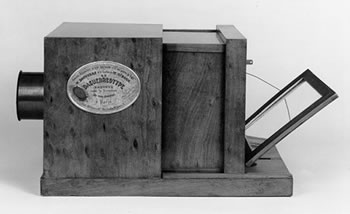
In the early 19th century, polymaths who wanted to use technology to improve their art (like Louis Daguerre) partnered with inventors and chemists to attempt to create lasting photographic images. Fine artists probably thought the scientific tinkering was more akin to alchemy than art, and it took several decades for the technology to develop into something easily utilized by artists. Even today, photography hasn't lost its technical roots -- after framing the shot and clicking the shutter, you still have to develop the film properly, expose the paper to the right amount of light, and chemically develop the photograph itself: art and technology swirling together. Digital photography offers the same swirling, but the chemicals have been swapped for pixels, and now pretty much anyone can do it.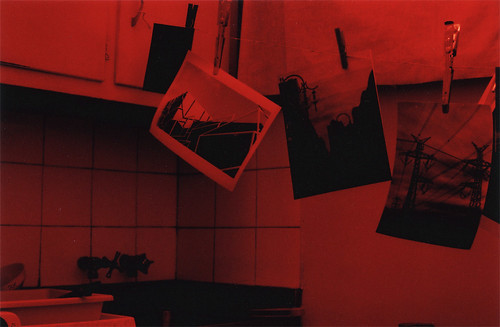
I think what the photography analogy suggests, more than anything else, is that we may be expecting too much too soon, digitally. In New Media Poetics (due in paperback from MIT Press in October 2009), the editor Adalaide Morris brings up an interesting visionary from the early years of the 20th century: Gertrude Stein. Morris writes, "For Stein, we are, each and every one of us, nimble citizens of an always newly technologized, mediated world that hasn't yet entered, much less altered, our categories of thought" (Morris 2). Now, as then, we're living IN the technology even as we're developing the categories and language to conceptualize its significance. Merriam-Webster added the phrase "personal computer" to their dictionary in 1976. "E-mail" in 1982, "internet" in 1985, "e-book" in 1988 (surprisingly), "blog" in 1999, and "google" as a verb in 2001. We're talking IN MY LIFETIME, people, and we all know how quick Merriam-Webster is to allow new words into its fold.
In an artistic time continuum that, in the past, went from technological development to creative production to public appreciation, where will consumer demand figure in? And is digital technology ready to become a popular literary medium (rather than an experimental one)?

EMILY PULLEN grew up, went to college, and cultivated her love for books and corn in Iowa. She discovered her love of bookstores in Boston, and currently works at Skylight Books in Los Angeles. She believes strongly in the symbiotic relationship between indie bookstores and indie publishers, and one day she hopes to be involved in some sort of hybrid of the two. She is also currently serving on the Bookseller Advisory Council of the ABA and the Emerging Leaders Council of young booksellers. Her favorite authors include William Faulkner, Don DeLillo, and Jeanette Winterson.

 Posts
Posts


