
I'm trying to catch up from a raunchy Sunday afternoon chock-full of awesome computer viruses and Disney Princesses on Ice.
Yesterday, Xiaoda Xiao's "searing" memoir-in-stories, The Visiting Suit: Stories From My Prison Life got a pretty terrific review from The New York Times Book Review. They said, "[Xiao] recount[s] his struggle in sometimes unexpectedly lovely detail. Against great odds, in the grimmest of settings, he manages to find good in the darkness."
I was glad they seemed to focus on this point. Certainly, it's a bleak story, that of his imprisonment, but what is most striking to me about the work is Xiao and his fellow inmates' desire to survive with their dignities and passion intact.
This past weekend, Grace Krilanovich was interviewed by Jonathan Bastion of Aspen Public Radio as part of the program 'Page by Page's' special segment on "Young Fiction Masters." Grace was spotlighted alongside Adam Levin, author of The Instructions. Check it out!
And, last but not least, the blog Three Guys One Book spotlighted Emily Pullen as part of their Why We Love What We Do feature, allowing Emily to dish on her favorite parts of bookselling and working at Skylight. It's clear that Emily's exceptionally passionate about BOOKS and reading, and we feel really lucky to have her as part of our team.
Also, through Emily, we'll be sharing a booth with Skylight Books at this spring's Los Angeles Times Festival of Books, which we're genuinely excited about. More on that to come.
Showing posts with label Emily Pullen. Show all posts
Showing posts with label Emily Pullen. Show all posts
Monday, January 24, 2011


Wednesday, September 08, 2010
Life is Better on the Left Coast
 For anyone within driving distance of Los Angeles, on Thursday, September 9 at 7:30 -- tomorrow!!! -- be sure to check out Joshua Mohr and Grace Krilanovich reading from their new novels at Skylight Books in Los Feliz.
It's bound to be exceptional.
The event will be Grace's first reading in support of her debut novel, The Orange Eats Creeps, and sort of serve as the launch party for the book. To that end, there will be wine.
You'll also be able to say 'hey' to the newest TDR-er, Emily, who'll be introducing the reading.
Seriously good times. G-D I wish we lived on the west coast.
Tuesday, August 24, 2010
Welcome, Emily Pullen

We met Emily Pullen at BEA in New York City in May 2009. She was friendly, encouraging, intelligent, self-effacing, and easy to talk to, and we've managed to stay in touch since then. She's contributed a piece to our blog on how the e-book trends may parallel the history of photography, and writes for places such as The Millions and Shelf Awareness, as well as the Skylight Books blog, so it's been fairly easy to track her thoughts on books and publishing over time.
We're really excited that Emily has agreed to work with us at Two Dollar Radio. Like the rest of us, she'll be wearing several hats but will be focusing on bookstore and library outreach, editing, print vs. e, and a couple significant company ventures we've yet to announce (more info coming soon).
She took some time to answer a few questions about herself after returning from her high school reunion.
Ed: How was your 10-year reunion?
EP: Unexpectedly, I realized that the year one graduated from high school is a pretty arbitrary marker of commonality these days. Most of the people I was closest to while I was in high school either were not in my class, didn’t attend my school, or were older than me. It’s interesting to see the vastly different things that people are doing, but after a couple of hours, I was done. So many people are married with kids and houses (and none of us are 30 yet). And that’s pretty far from where I am (or really want to be) at this point…
Ed: What are some good books you’ve read recently?
EP: The Thousand Autumns of Jacob de Zoet by David Mitchell
Room by Emma Donoghue
The End of Vandalism by Tom Drury
Bluets by Maggie Nelson
Nox by Anne Carson
AM/PM by Amelia Gray
Stuck Rubber Baby by Howard Cruse
Ed: I remember seeing somewhere you talking up Asterios Polyp…
EP: I’ve been reading graphic novels for about 3 years now, and I realized that what I love in prose, I also love in graphic novels and other mediums. Asterios Polyp conveys meaning and story and mood in so many different ways, and my favorite fiction does that as well. My favorite nonfiction books do that. My favorite art books do that. There is a sort of resonance, a feeling of concentric ripples influencing each other. Another graphic novel that does that is Jeff Lemire’s The Complete Essex County.
Ed: You work at Skylight Books. Can you tell us a fun bookstore story?
EP: My moment of crowning glory so far was the Infinite Summer + David Foster Wallace tribute that I organized last September. 100 people. Food. Games. Speeches. Celebrities. This feeling of solidarity, of having both accomplished something and gone through something together – both Infinite Jest and the loss of DFW. We played badminton in the bookstore (tennis might have been destructive). Actor John Krasinski read a monologue from Brief Interviews with Hideous Men. People who finished got to sign our poster. I don’t know, it just felt like we had become, for a few hours, exactly what a bookstore should be: a community hub where diverse people with something in common share books, food and conversation. It was amazing.
Ed: You’re involved in the Emerging Leaders Council of the American Booksellers Association. All anyone reads about in the media are doom and gloom reports on book publishing. What’s a positive thing going on that you’ve seen from your vantage point as a bookseller?
EP: There’s nothing better than adversity to help create a feeling of solidarity among booksellers. Though I’ve been a booklover all my life, I’ve only been involved in the industry since 2004. So much change is happening right now, culturally. It is an utterly fascinating time to be alive. I think that the bookstores (and small publishers) who are most suited to survive are the ones that develop partnerships between seasoned booksellers who have been refining their craft for a long time and younger booksellers who can adapt and incorporate new technologies more nimbly. I never cease to be amazed at how many smart, passionate, and committed people are involved in books. Now, if only someone could actualize Hermione Granger’s Time-Turner and pass them out to booksellers…
Also, there’s a Bookrageous calendar coming out soon – book people from all parts of the business doing ridiculous things for the love of books. Of course I’m in it. No, I can’t tell you what I’m doing. (Ed: You can order it here.)
Ed: Could you give us a generic professional bio?
EP: I grew up in Iowa and attended Grinnell College. I completed a double major in English and Sociology, and graduated With Honors in both departments in 2004. Then, I went to Boston, hoping to get my foot in the door of the publishing industry. I landed in bookstores instead, first at Wordsworth Books in Harvard, and then at the newly opened Porter Square Books. Life brought me to Los Angeles and Skylight Books in 2006, where I’ve been ever since. I attended the ABA Winter Institute in Louisville in 2008, and amazing opportunities have come since. I joined the Emerging Leaders Council and was asked to be on the ABA’s Bookseller Advisory Committee. I thought about attending graduate school, but at this point, I feel I can learn more being smack dab in the middle of it. I love being able to talk about books with publishers, authors, customers, and booksellers at any time of day or night. Ah, that’s the life. Now, if only I still had time to read…
Tuesday, August 11, 2009
Uniquely Calibrated Cultural Noise Filters
By Emily Pullen
After a somewhat frustrating week where it seemed like computers and databases and websites were crashing at every turn, it was refreshing to open a book and have it still work. There is something to be said for a technology that has been pretty reliable for the last 500 years or so. (RIP 8-track players and virtual reality.)
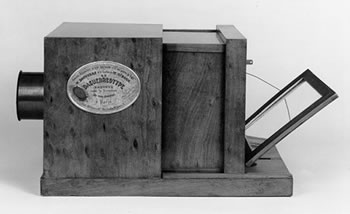
In the early 19th century, polymaths who wanted to use technology to improve their art (like Louis Daguerre) partnered with inventors and chemists to attempt to create lasting photographic images. Fine artists probably thought the scientific tinkering was more akin to alchemy than art, and it took several decades for the technology to develop into something easily utilized by artists. Even today, photography hasn't lost its technical roots -- after framing the shot and clicking the shutter, you still have to develop the film properly, expose the paper to the right amount of light, and chemically develop the photograph itself: art and technology swirling together. Digital photography offers the same swirling, but the chemicals have been swapped for pixels, and now pretty much anyone can do it.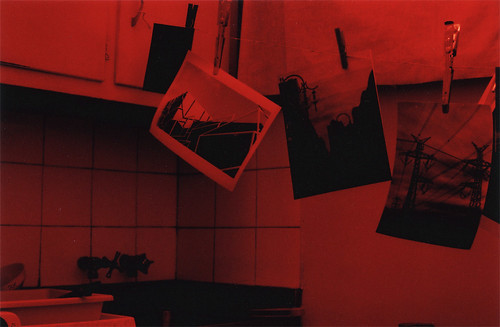
I think what the photography analogy suggests, more than anything else, is that we may be expecting too much too soon, digitally. In New Media Poetics (due in paperback from MIT Press in October 2009), the editor Adalaide Morris brings up an interesting visionary from the early years of the 20th century: Gertrude Stein. Morris writes, "For Stein, we are, each and every one of us, nimble citizens of an always newly technologized, mediated world that hasn't yet entered, much less altered, our categories of thought" (Morris 2). Now, as then, we're living IN the technology even as we're developing the categories and language to conceptualize its significance. Merriam-Webster added the phrase "personal computer" to their dictionary in 1976. "E-mail" in 1982, "internet" in 1985, "e-book" in 1988 (surprisingly), "blog" in 1999, and "google" as a verb in 2001. We're talking IN MY LIFETIME, people, and we all know how quick Merriam-Webster is to allow new words into its fold.
In an artistic time continuum that, in the past, went from technological development to creative production to public appreciation, where will consumer demand figure in? And is digital technology ready to become a popular literary medium (rather than an experimental one)?

EMILY PULLEN grew up, went to college, and cultivated her love for books and corn in Iowa. She discovered her love of bookstores in Boston, and currently works at Skylight Books in Los Angeles. She believes strongly in the symbiotic relationship between indie bookstores and indie publishers, and one day she hopes to be involved in some sort of hybrid of the two. She is also currently serving on the Bookseller Advisory Council of the ABA and the Emerging Leaders Council of young booksellers. Her favorite authors include William Faulkner, Don DeLillo, and Jeanette Winterson.
Subscribe to:
Posts (Atom)

 Posts
Posts


