Showing posts with label Francis Levy. Show all posts

Friday, December 30, 2011

O 2011, Where Did You Go? A recap of sorts.

2011 just blew past and we thought we'd take a moment to slow it down and share some of our most memorable TDR moments from the year.

We'd love to hear from other folks, too, readers or authors as to what some of their favorite times from the past year were, whether with our books or others, so please chime in!

Here are some of those moments we'll remember, in no particular order.

Barbara Browning appearing with Keren Ann at Barnes & Noble's Upstairs at the Square.
Barbara's debut novel, The Correspondence Artist, inspired Largehearted Boy to declare the book "one of the true literary breakthroughs of our young century," and thankfully we have this utterly fantastic video of her in conversation with Katherine Lanpher at a joint event with Keren Ann.


Grace Krilanovich's The Orange Eats Creeps makes the editors' shortlist for The Believer Book Awards.
"Grace Krilanovich’s first book is a steamy cesspool of language that stews psychoneurosis and viscera into a horrific new organism—the sort of muck in which Burroughs, Bataille, and Kathy Acker loved to writhe."
And while it didn't win, we're certain it made an impression.

Michael Schaub reviews Jay Neugeboren's You Are My Heart and Other Stories at Kirkus.
"[Neugeboren] might not be as famous as some of his compeers, like Philip Roth or John Updike, but it's becoming increasingly harder to argue that he's any less talented. Neugeboren's new short story collection serves as a convincing piece of evidence of the author's rare talent... dazzlingly smart and deeply felt... Jay Neugeboren is music to our ears."
That's why it was memorable, a better appreciation for this acclaimed author could not have been written.

Francis Levy pisses off Brazil.
The publication of Francis Levy's satirical second novel, Seven Days in Rio, inspired the Village Voice to declare the work "the funniest American novel since Sam Lipsyte's The Ask" and others to praise this "incredibly elaborate and well-crafted satire." There were voices of dissent, such as Brazilian government officials quoted in O Globo, the most prominent daily newspaper in the country, saying they would demand an official apology for the book's publication.
This would have to win for most surreal happening for us of 2011.

Roadtripping with Joshua Mohr.
We were thankful to be able to convince Joshua Mohr to tour the midwest for the third book of his that we published, Damascus, which led to us eating this Chicago-style pizza:

Josh reading in a chapel at Capital University:

And in a basement at Mac's Backs in Cleveland:

While some super-cool things happened with Damascus, such as the Wall Street Journal and New York Times reviews, and the USA Today year-end mention, the most memorable part of the publication for me will be this trip, the camaraderie, talking books and writing and everything else with a dear friend.

Getting some hometown love from The Columbus Dispatch.
When you work out of your house, it can get kind of lonely, and so it was great to get some local print from our hometown paper that allowed us to open our doors and share what we do with our neighbors and community. Plus, it was really wonderfully written.

Tuesday, November 01, 2011

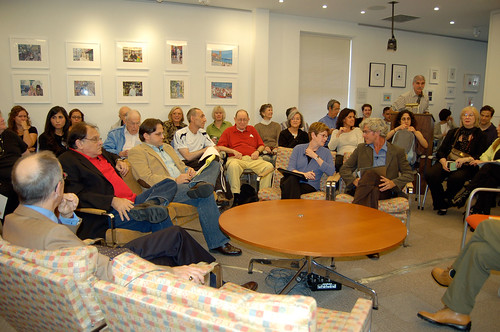
Francis Levy at the East Hampton Library

Author Francis Levy reads from his new novel, Seven Days in Rio, at the East Hampton Library.

Friday, September 02, 2011

You're Invited!

THE COMMITTEE FOR THE DEFENSE OF THE FICTIONAL IMAGE OF RIO, EVEN IF IT MEANS BURNING BOOKS AND CREATING THREATENING EFFIGIES OF DESPISED WRITERS, INVITES YOU TO A READING AND PUBLIC RECANTING

WHEN: SEPTEMBER 8, 2011

WHERE:  THE SIDEWALK CAFÉ (94 Avenue A at Sixth Street NYC)

TIME: 6:15

Mr. Levy has allowed himself to be put in stocks for this reading so that he may demonstrate how sorry he is for offending not only the people of Rio, but mankind in general. Since publishing SEVEN DAYS IN RIO, Mr. Levy accepted an invitation from the Brazilian government to view the destruction that his novel has wrought. After touring devastated areas of the city, Mr. Levy described being shocked by all the untruths that his character Kenny Cantor perpetrated in the novel.

Mr. Levy saw no evidence of pickpockets anywhere and performed a test whereby he left $l0,000 in small denominations on a public bench near the Copacabana. When he came back from a walk on the beach, the money was all there and his frenzied attempts to find thieves or anyone who would take it were unsuccessful. One resident of the city suggested that the reason why the money wasn’t taken is that the Brazilian economy is booming and $10,000 American dollars is not worth the trouble for the city’s affluent populace. Eventually, Mr. Levy had to hire a cleaning service to sweep the money away— in order to avoid getting a ticket for littering.

As for prostitutes, Mr. Levy is not sure where Kenny got his ideas from. Mr. Levy found that the Copacabana, one of the most famous beaches in Brazil, was filled with nuns in habits. Not able to find any members of the world’s oldest profession in a city where women who might have sold their bodies now earn higher wages selling derivatives, Mr. Levy hired a private detective service, Three Guys, named after the popular coffee shop opposite the Whitney. Three Guys helped him to locate some alumnae working girls in the financial services industry.  But Mr. Levy was shocked to find that none of the former prostitutes he interviewed had ever heard of Susan Sontag. Through no fault of his own, Levy again found that he’d been duped by his own character.

“Basically, I was receiving misinformation from this fictional individual. I have no intention of shirking responsibility for my crimes. I’m not trying to say that I was just taking orders, but I’m clearly a victim too. I also think that Kenny’s attitude towards psychoanalysis is totally distorted. He treats psychoanalysts like whores who bilk their wealthy patients. Anyone who has ever been psychoanalyzed knows this is a myth. The average psychoanalyst is happy to listen to neurotic patients expressing the same fears four times a week without receiving a penny’s worth of compensation, and he or she is happy to work nights on the loading dock of a supermarket to support his passion for listening to repetitive drivel. In sum, I am more than ready to accept any punishment that the people of Rio and the profession of psychoanalysis wish to dole out. It is the only way to relieve me from the huge burden of guilt that I am carrying for my transgressions. I would suggest that I be spanked, lashed and crucified, with my naked body hammered to a cross, but I’m afraid I would enjoy those punishments too much. Instead let me be yelled at and nagged to death. Let the punishment fit the crime.”

COME EARLY SEATING IS LIMITED!

Tuesday, August 30, 2011

Brazilgate 2011

The most prominent daily newspaper in Brazil, O Globo, quoted government officials saying they'll request an apology for the US publication of Seven Days in Rio by Francis Levy, as well as write a letter to the US Embassy. The article elicited nearly 350 comments from readers of the paper, some outraged while others found the matter trivial. O Globo quotes Aparecida Gonçalves, the secretary for combating violence against women, a government body that reports to the presidency, insisting that all Brazilians must be "treated well, even in fiction."

We include a fiction disclaimer on the copyright page of all our books, but in addition, the author penned a prologue that kicks off the novel, stating:

"None of the characters in this novel are real, nor are the places or the psychoanalytic movements, even though the name Rio may conjure the real city of Rio de Janeiro. Lacanian analysis as described in the novel bears no resemblance to the branch of psychoanalytic practice initiated by the French analyst Jacques Lacan. Even the duration of time stated in the title bears little resemblance to what is commonly known as seven days. So don't start writing irate letters to my blog correcting this or that or asking for refunds."

We understand it to be natural for people to feel protective of their community. It was clear from the comments posted to the O Globo website that there is a greater cultural discussion ongoing, and we don't believe a work of satire by an American writer, never presented as anything other than fiction, belongs in that cultural discussion. It is also apparent from the O Globo article that the quoted official never read the book before demanding an apology, which is unfortunate.

Joshua Mohr pointed out to me that this all sounded familiar to when government folk in Brazil got in a tizzy in reaction to a Simpsons episode. According to BBC, "Simpsons father Homer was kidnapped by an unlicensed taxi driver, and he and son Bart were robbed by street children... Bart was at one stage swallowed by a boa constrictor, and Rio's slums appeared to be dirty and dangerous."

Wednesday, August 17, 2011

Fav Lines from Seven Days in Rio

Francis Levy's Seven Days in Rio got a killer-sweet review on Chuck Palahniuk's site, The Cult the other day.

From the review: "It's like an erotic version of Luis Bunuel's The Discreet Charm of the Bourgeoisie. Levy is matter-of-fact in his raunchiness, which is try-and-suppress-your-laughter-because-people-are-beginning-to-stare-at-you funny. The man is fearless in his exploration of human sexuality."

The review, by Joshua Chaplinsky, referenced the laugh-out-loud nature of some of the lines so we thought we'd revisit this original post featuring some of our favorite lines from the novel.

Seven Days in Rio, a novel by Francis Levy, will be out on July 4 of this year. Here are some meaty gems from the book that I thought I'd share with you to whet your appetite:

"Author's Note: None of the characters in this novel are real, nor are the places or psychoanalytic movements, even though the name Rio may conjure the real city of Rio de Janeiro. Lacanian analysis as described in the novel bears no resemblance to the branch of psychoanalytic practice initiated by the French analyst Jacques Lacan. Even the duration of time stated in the title bears little resemblance to what is commonly known as seven days. So don’t start writing irate letters to my blog correcting this or that or asking for refunds."


"Besides sex, one of my obsessions is clean air, and I try to engage in sexual acts that don’t release any toxins into the atmosphere."

"I sometimes think that there should be a support group for people who, like myself, are always missing something."

"Our parting had felt a little like the last scene of Casablanca. There was no plane waiting to take her away from me, there was no heroic resistance leader standing between us, no war, and I wasn’t a hardened American expatriate named Rick. Yet I felt I could hear the strains of “As Time Goes By” playing on the piano in some beat-up North African café."

"“I’m a traveler who has become waylaid,” I said holding out a real. “I’m a little like Odysseus. I started out my journey looking for beautiful prostitutes, but I have been experiencing famine amongst plenty. Now I feel like Robinson Crusoe. Except I haven’t been washed up on an island, and consequently have found no Man Friday to show me the way.”"

"He looked like the kind of guy who had spent his life as a night watchman and now, in retirement, just watched over things on a recreational basis."

That's just a sample. Like the sampler appetizer you can order at Applebee's.

Tuesday, August 16, 2011

Q&A With Francis Levy

This Q+A was posted at some point last year, but with today being the official publication date of Seven Days in Rio, we figured we'd revisit it.

In 2011, we'll publish Francis Levy's second novel, Seven Days in Rio. In 2008, we published his first book, Erotomania: A Romance, which may have received the most amusing pull-quotes from reviews of any book we've published.


The Village Voice called Levy "Nicholson Baker and Mary Gaitskill's French-kissing cousin." Inland Empire Weekly said he was "our generation's DH Lawrence, Henry Miller and Charles Bukowski rolled into one." And the Los Angeles Times said "Levy's excellent too, like Miller and Bukowski, on the mechanics and energy and animal filth of rumpy-pumpy." (Rumpy-pumpy?)


Here's a brief Q&A with Levy to mark the occasion:


Erotomania made some year-end best-of lists and got some over-the-moon postive reviews, but there were places, such as the Seattle Stranger, who "abandoned" reading the book. As an editor, I found the love/hate knee-jerk reaction to Erotomania both exceptionally rewarding and enjoyable -- what is the point of art if not to inspire and provoke. What was your reaction as a writer?


FL: I'm a naturally provocative person. It doesn't take much for me to provoke and there was a time in my career when the provocation actually produced it's desired effect which I suppose was to steel myself up against anticipated rejection. I for instance had written a series of letters from Jews to Herr Hitler asking to be excused from the Holocaust.The letters played upon all the elements of Jewish self hatred that were evident amongst the ambitious, assimilationist crowd I grew up around. People in my little fiction would plead to be excused from the Holocaust because they didn't look or act like the other Jews. The piece by the way was called "Passive Resistance," a title that also got me into trouble since that mode of social protest was tied to folks like Gandhi and Martin Luther King who most educated readers idolize. "Passive Resistance" was appreciated by some, but reviled by others and managed to create the effect someone has when they walk into a room after soiling themselves, even though it never actually got published.


Then I wrote another parody "Joseph Mengele:Man of Science" and yet another one in which Hitler is in a rehab for recovering dictators and tells his story, how he took the Sudetenland, but it was not enough. He was portayed like a sexual compulsive who is addicted to conquests. In those years, I was actually enraged and the rage was barely sublimated so the net effect was to give the reader material they found hard to digest. Mind you others like Phillip Roth and Wally Shawn had dealt satirically with subjects like Jewish self hatred and facism. It's the same material that Mel Brook's dealt with in the original movie of The Producers with its infamous number "Springtime for Hitler."


Provocation is really the comic form of tragedy, or tragic comedy. Look Erotomania is a tragi-comedy. James and Monica exemplify evolution on an ontogenic basis. They start as animals and the overly developed cerebral cortex gets in the way. The higher brain activities cause them to lose all the fun. The only problem is they wouldn't have realized they were not having fun unless they had consciousness, nor would they have had the pleasure of getting to know each other and getting to experience other forms of enjoyments such as mimesis, such as art, such as food. Freud wrote about this in Civilization and Its Discontents. I don't know why that book is not a perpetual bestseller. It should be in the drawer of every motel room like the Gideon Bible once was, giving the lonely traveler a little bit of gospel and the solace of knowing why he is so torn.


In a nutshell, Erotomania wasn't provocative because of the sex, though there was almost as much of it in the book as there is in life. It was provocative because of its rather upsetting message, which is again Freud's message i.e. that in the course of being human and socializing, man must forego certain things. Instinct will become compromised by the inhibitions that accompany consciousness. The book was also upsetting because my couple, who I really fell in love with myself, eventually embark upon a project which causes them to explode. Here again, hyperbole was simply underlining a truth: that we all separate and individuate only to be reunited again with common matter in death. My feeling is that some people simply don't want to read these things. It's like Spielberg's A.I. A lot of filmgoers didn't like the movie, but not because it was a bad movie. Rather the movie said something that was upsetting in the case of A.I. that the species could perpetuate itself, consciousness could exist without the body.


On the surface level, Erotomania was the arc of a couple as they perfect their relationship, is Seven Days in Rio the story of a man searching for the perfect relationship . . . with a prostitute?


FL: Not really. In essence Seven Days is about a sex tourist who gets waylaid at a psychoanalytic convention. It's not an autobiographical novel in any sense of the word. To begin with, I have never been to Rio, but it's far more more personal in a poetic way than Erotomania was. In essence I'm the sex tourist who got waylaid at the psychoanalytic convention, though to bookend I have never been to a psychoanalytic convention either.

However basically in some harum scarum way Seven Days tells my story. I recently published a piece about my own analysis in American Imago, a scholarly journal founded by Freud and Hanns Sachs in l939. It's called "Psychoanalysis: The Patient's Cure" and it tells the story of my own analysis. In one of the early parts of the piece I describe how I was beaten up outside a bottomless bar called Diamond Lil's which was on Canal near White Street in the 70's. I don't know what caused me to get worked over by the bouncers. I must have done something provocative to get back to the subject of the kind of provocation that doesn't delight audiences. For instance back in those days I had the habit of getting blind drunk and doing things like pulling on a fellow nudie bar aficionado's beard. People don't like that kind of provocation, but I didn't know that. I had to be told, in fact, that this was very naughty, very bad and that it would provoke the ire of those to whom it was done. That same night I went down the street to a famously violent Punk Rock place called the Mudd Club where women and I suppose some men were routinely raped in the bathroom. I had been knocked out during the beating and when I got up my arm was hanging out of its socket, but I thought "this is pretty cool" and proceeded on my merry way, drinking and using my dangling limb as a conversation piece with bug-eyed women blasted out of their minds on who knows what. In any case, the incident was one of many in which I was playing around with my own death. My self undoing had reached a certain pitch were it became apparent that I might truly succeed in having an ending like that of some of my idols, from Jackson Pollock who rammed his car into a tree, to Janice Joplin and Sid Vicious and in a more literary vein, John Berryman and Sylvia Plath. I had to really think about it at the time: did I want to live or die?

In the Myth of Sisyphus Camus says this is the only real philosophical question, but this wasn't intellectual matter for me. At the time, I simply hated myself and every night I went out on the town in the pursuit of so-called pleasure, I had yet one more opportunity to tempt fate. That's the odd thing about the thing that people call pleasure. Often what people call pleasure or ecstasy masks the search for oblivion. Epicurus is a philosopher whose name is often associated with pleasure, but he believed in the golden mean. Pleasure for him was not indulgance in excess, but a realization of limitation. These are some of the themes are set out to explore in Seven Days.

Seven Days in Rio begins with an amusing disclaimer of sorts: "None of the characters in this novel are real, nor are the places or psychoanalytic movements, even though the name Rio may conjure the real city of Rio de Janeiro. Lacanian analysis as described in the novel bears no resemblance to the branch of psychoanalytic practice initiated by the French analyst Jacques Lacan. Even the duration of time as stated in the title bears little resemblance to what is commonly known as seven days. So don't start writing irate letters to my blog correcting this or that or asking for refunds."

FL: Kafka wrote a novel called Amerika, though he never visited America. I was studying romantic French literature of the l9th Century like Chateaubriand's Atala. I started to read certain kinds of novels based on the writer's imagination of places they only partially knew. I suppose the advent of the New World inspired much fantasy. Being a person who baths in a world of sexual imagery (like most human beings, even if they might not always realize it or want to realize it), I am always imagining my Erewhon, my Utopia, both in terms of sex and its cousin therapy. I have no illusions about Rio or Bangkok or anything. In fact, after all these years of living what many people might called a hum drum existence (being a father and husband and parenthetically loving these activities), who at the same time conjures up altenative universes (I hope none of the family of man takes offense at my claiming that this is also being a trait of the species), I think I might commit suicide were I to confront the banality of pleasure.

The allusion to Hannah Arendt's "banality of evil," the famous phrase she used to describe Eichman is not coincidental and in part explains the disclaimer at the beginning of the novel. Were I to journey to a sexual and/or therapeutic paradise where I could finally meet a beautiful analyst who consented to sleep with me I would in all likelihood be disappointed. It's much better to write about these things. Then I'm free to come and go as I please with minimum destruction to other human beings.

You recently published a very thoughtful and reflective piece in American Imago on your relationship with your own psychoanalyst. How has psychoanalysis informed and furthered your fiction writing?

FL: I have already inadvertently answered this, but let me approach it from another angle which is to say the general question of the inner life. Analysis places a great amount of importance on the inner world. This may sound like a simple idea, but think about it. Most people go into therapy to solve a problem. Some men for instance go into therapy because they are having problems with sex; they have performance anxiety which leads to erectile dysfunction, in lay terms not getting it up. This is a serious matter for a man. I have a feeling that this is what Goethe's Faust is all about. Men will do anything for knowledge about how to solve this difficulty, even going so far as making a Mephistolean bargain.

Okay, I'm being facetious, before the lynch mob of comp lit scholars comes after me, I'm only kidding (not!). In contradistinction to this the analytic enterprise, looks at the whole human character. It's not that some symptoms aren't treated, rather it's a cart and horse matter. Instincts and desires are a part of the humanity of the individual. The idea is that something is getting in the way and that something becomes the subject of the analysis. In the course of this, you embark on a kind of inner life party. I was already fairly practiced in doing emotional striptease before I got into analysis, but the analysis opened up a rich territory which became my palette and eventually the raw stripping, in which I would get attention by exhibitionistically revealing everything, got turned into a ballet, then a piece of modern dance, then a tableau vivant a la Robert Wilson and then novels like Erotomania and Seven Days. I also started to produce a blog called The Screaming Pope. I've also written over 2000 poems, numerous humor pieces and short stories. I don't know if my analyst is totally aware of it, but all his years of treatment created a Frankenstein.

As co-director of the Philoctetes Center for the Multidisciplinary Study of Imagination, you come into contact with some of the most relevent thinkers of our time -- what are some of your memorable moments from the Center?

FL: I'm a bit of an intellectual groupie. I like all kinds of weird thinkers known and unknown. I've become friends with several writers published by Two Dollar Radio. Larry Shainberg, the author of Crust, and the classic Ambivalent Zen recently joined a panel on religious extremism called "The Politics of Ecstasy." Barbara Browning, whose The Correspondence Artist, you are publishing this year, was on the David Shields panel "The Lure and Blur of the Real" and that's an example of the the kind of thing that thrills me. The fine line between reality and fiction was what Shields was writing about and along comes Barbara Browning whose fictional characters (are they fiction?) engage in dialogues with real people on line and elsewhere. We had touched on something in the zeitgeist and it was a very exciting and contentious too. Shields and Rick Moody really fenced off on the issue of fiction qua fiction as opposed to reality as fiction or fiction as reality. John Cameron Mitchell who directed one of my favorite movies, Short Bus, was also on that panel.

Okay now I'm going to behave like the kind of asshole I hate. We had Turturro and Edward Albee talking about Beckett. We had Nicholson Baker and Judith Thurman on biography and autobiography. We had Dan Rather on civil wars in Afghanistan and Bosnia. We had the astrophysicist Brian Greene talking to the Harvard esthetician Elain Scarry about math and beauty. We had Christopher Ricks and Sean Wilentz on Dylan, the Nobel prize winning Neuroscientist Gerry Edelman talking about disenchantment in a panel on norms, Phillip Pearstein, Chuck Close, Kiki Smith. The list goes on. I'm proud of it so fuck me if I'm namedropping. Fuck me, fuck everyone. How's that for provocation?

Here's the opening to Seven Days in Rio:

"I went down to the Copacabana on my first night in Rio. I was told that most of the women were prostitutes who would gladly sleep with me for a hundred American dollars. I saw a sexy looking woman wearing high heels and an abbreviated bikini and decided that there was no sense in discriminating, since all the women were going to turn out to be whores and, from what I’d heard about the lovemaking habits of Brazilians, one would be as talented as the next. I pursed my lips and made purring sounds like a pussycat to get the idea across, but the woman didn’t seem to notice me, although I was wearing a seersucker suit from the Brooks Brothers 346 collection. There aren’t too many men, or women, wearing Brooks Brothers suits (or any suits for that matter) down by the Copacabana, and I would have thought I stood out from the crowd.

"I have always found communication between myself and other human beings to be a problem, and often worry that I haven’t succeeded with women where I otherwise might because my words get caught between my teeth. So I just held out my hand to her as she waited for the traffic light to change. “I’m Kenny,” I said. “I have a big dick. Do you understand Anglais? I am new to your country and I wanted to introduce myself while also initiating myself into your highly permissive sexual culture. I will put my cards on the table. I’d be glad to engage you to perform sexual acts on me for a fee.”"

Friday, March 25, 2011

Support Philoctetes

Letter from co-directors of The Philoctetes Center, Francis Levy (author of Erotomania: A Romance and forthcoming Seven Days in Rio) and Edward Nersesian, M.D.:

Dear Friends,

We are always happy to share a few highlights from our current season of programs. Unfortunately, at this time, we have to leaven our good news with some bad news.

First, the good news. The Philoctetes Center's 2011 programs are off to a great start. The January 29 roundtable “The Nature of Reality,” moderated by Deepak Chopra, attracted a standing-room-only audience, many of whom returned for the subsequent roundtables in our “Big Questions” series—“The Limitations of Mental and Physical Reality” and “Theories of Everything.” In fact, turnout for our events has never been greater, and archival videos on our YouTube channel regularly attract thousands of online viewers.

Our poetry and music series continue to showcase the peerless talents of artists and scholars like Jane Ira Bloom, Lewis Porter, and Heather Dubrow, who have organized and hosted events featuring the likes of Marilyn Nelson, Jonathan Culler, Min Xiao-Fen, and Ken Wessel. And our activities have been recognized with renewed support from the New York State Council on the Arts, The New York Department of Cultural Affairs, The Axe-Houghton Foundation, The Aaron Copland Fund for Music, The Elsie Wunsch Trust, The Lindemann Abend Foundation, and Bloomberg, along with new grants and contributions from The New York Council for the Humanities, The Educational Foundation of America, Anthony Low-Beer, and, most importantly, supporters like you.

The bad news is that these funds only cover a portion of our roughly $200,000 annual budget, which has been streamlined to cover our most basic expenses: rent; utilities; salaries for our small, hardworking staff; and videography expenses (so that we can continue to share our events with an international online audience). As it stands, we currently have funds to get us through the next two months of programming. After that, we truly don’t know how we are going to continue providing what we believe is an important public service—enriching, one-of-a-kind programs that are free and open to the public.

Now more than ever, we rely on contributions from the people who enjoy our programs. Please consider supporting the Philoctetes Center with a contribution. You can access our Support page here and make a contribution by check or credit card.

Support Philoctetes

Warmly,

Francis Levy & Edward Nersessian, M.D.
Co-Directors

Saturday, March 05, 2011

Thought(s): Francis Levy

Francis Levy, author of Erotomania: A Romance and the forthcoming Seven Days in Rio has a parody of The New York Times' 'Corrections Column' in The East Hampton Star. Here are some favorites:

"In a front-page story our country was mistakenly identified as United States of America. The correct name is The United States of America."

"In Tuesday’s article about the budget, several erroneous statements were made. Offering Social Security benefits only to those in the highest income brackets in order to stimulate investment while eliminating Medicare and Medicaid reimbursements is not part of the current plan to reduce the trillion-dollar deficit."

"In Tuesday’s edition of Science Times, it was reported that the Large Hadron Collider, the most powerful particle accelerator in the world, could create a black hole, which would swallow up the universe. This report was based on rumors among a poll of college art majors and has not been substantiated by particle physicists who have studied the project."

"The Times reported on Thursday that Congress was increasing N.E.A. funding tenfold to bring American arts funding up to the level of France and England. The sentence in question should have read: “Congress has approved a 10 basis points or one-tenth of one-percent increase in arts funding.”"

Wednesday, November 10, 2010

Erotomania Optioned for Film

Hot news: Francis Levy's debut novel, Erotomania: A Romance, which was a Queerty.com and Inland Empire Weekly Best/Standout Book of 2008, was just optioned for film by director Greg Levins (Bittersweet) and producer Jason Tyrrell (The Brave and the Kind, All My Friends are Funeral Singers).

Tuesday, September 21, 2010

Because This Sounds Important

In, like, the '90s, my mom and the partner she ran her dance company with were on 60 Minutes for about a minute confronting a Senator from Ohio named John Kasich (now running for Governor to the state) who was garnering national media attention for trying to abolish the NEA.

The Philoctetes Center for the Multidisciplinary Study of Imagination at the New York Psychoanalytic Institute, of which Francis Levy (author of Erotomania and the forthcoming Seven Days in Rio) is a co-director (Edward Nersessian and Francis Levy, Directors), is hosting a rountable this Saturday, September 25, 2010 at 2:00pm at The Philoctetes Center 247 East 82nd Street (Phone: 646-422-0544; email: info@philoctetes.org). The rountable discussion will focus on arts funding past and present.

This event is free and open to the public.

From the WPA to the NEA: Arts Funding Then and Now

The WPA, one of the central programs of Roosevelt's New Deal, was pivotal in providing a template for government subsidy of arts projects, producing one of the great periods of creative expression in the history of American society. Playwrights like Arthur Miller and Elmer Rice flourished under the WPA’s Federal Theater Project, directed by Hallie Flanagan. Federally funded projects sowed the seeds for America's ascendency as the center of modern art, particularly with the emergence of abstract expressionism in the late ‘40s and ‘50s. The WPA and the New Deal fostered a renaissance that affected the very fabric of American society, instilling a confidence that helped lead the country back to prosperity. This panel will look at how and why the WPA stimulated creative growth during a crucial period in American history, and examine the ways in which government subsidy of the arts can foster a sense of social identity.

Morris Dickstein is the author of Dancing in the Dark: A Cultural History of the Great Depression, winner of the 2010 Ambassador Book Award in American Studies. He is Distinguished Professor of English and Theatre at CUNY Graduate Center and the author of Gates of Eden and Leopards in the Temple, among other works.

Rocco Landesman is the tenth chairman of the National Endowment for the Arts (NEA). Prior to joining the NEA, he was a Broadway theater producer. After receiving a doctorate in Dramatic Literature at the Yale School of Drama, he served there for four years as an assistant professor. He ran a private investment fund until his appointment in 1987 as president of Jujamcyn, a company that owns and operates five Broadway theaters. Landesman has produced several Tony award-winning Broadway hits, most notably Big River, Angels in America, and The Producers. He has been active on numerous boards, including the Municipal Arts Society, the Times Square Alliance, The Actor's Fund, and the Educational Foundation of America. Landesman has spoken at forums and written numerous articles on the debate surrounding arts policy.

Susan Quinn is the author of A Mind of Her Own: The Life of Karen Horney; Marie Curie: A Life; Human Trials: Scientists, Investors and Patients in the Quest for a Cure; and Furious Improvisation: How the WPA and a Cast of Thousands Made High Art Out of Desperate Times. Quinn received the Globe Winship award for A Mind of Her Own, and was awarded a Guggenheim Fellowship and Rockefeller residency to work on her biography of Marie Curie, which was a finalist for the Los Angeles Times Book Prize, shortlisted for the Fawcett Book Prize in England, and won the Grand prix des Lectrices d'Elle in France. Quinn has been a staff writer at Boston Magazine, where she won the Penney-Missouri Magazine Award for investigative journalism, and has contributed to The Atlantic and New York Times Magazine, among other publications. She is currently at work on a book about the friendship of Harry Hopkins and FDR.

Leslie G. Schultz is the Executive Director of BRIC Arts Media Bklyn, a non-profit cultural institution dedicated to supporting the creative process and presenting innovative and accessible contemporary art, performing arts, and community media programming that reflects the diverse communities of Brooklyn. Under her leadership, BRIC has rebranded, restructured, expanded its programming, developed and implemented a new strategic plan for institutional growth, and secured public and private support for the creation of BRIC Arts Media House, a multidisciplinary arts and media center designed by award-winning Leeser Architecture that will double the size of BRIC's current facilities. Prior to BRIC, Leslie was a partner at the law firm of Manatt Phelps & Phillips and its predecessor firm, focusing on capital projects for a range of non-profits and on non-profit governance and corporate affairs.

This program is supported, in part, by public funds from the New York City Department of Cultural Affairs, in partnership with the City Council.

_______________________
Events at Philoctetes are free and open to the public. Seating is on a first come basis.

The Philoctetes Center for the Multidisciplinary Study of the Imagination was established to promote an interdisciplinary approach to the understanding of creativity and the imaginative process. To achieve its mission, the Center organizes roundtable discussions and music, poetry and film series. All programs are free and open to the public. Visit philoctetes.org for more information.

Monday, June 14, 2010

Santutxo Etxeberria in BOMB; Nixon's Nose in Guernica

Dig it, some sneak peeks at forthcoming Two Dollar Radio titles:

The summer issue of BOMB Magazine is now out. In it, you will find an excerpt from Barbara Browning's forthcoming THE CORRESPONDENCE ARTIST, called 'Santutxo Etxeberria.'

Browning will be reading with other BOMB contributors July 13 in Tompkins Square Park.

In other reading news, Francis Levy will be reading tomorrow (Tuesday) night from his new novel, SEVEN DAYS IN RIO, at the Writer's Room in NYC.

If you missed it, Guernica Magazine excerpted THE VISITING SUIT: STORIES FROM MY PRISON LIFE by Xiaoda Xiao in their June issue. The story, titled 'Li Minchu - The Cost of a Dream' in the book, re-dubbed 'Nixon's Nose' at Guernica: "In Maoist China, a political prisoner feels his way through a Kafkaesque tableau of rumors, betrayal, interrogation, and execution."

Read 'em at the beach, at the lake, or with your feet dipped in the ankle-deep water of a kiddie pool.

Friday, November 06, 2009

If I Was in NYC I'd be at Philoctetes

Francis Levy, author of Erotomania: A Romance, is one of the co-directors of the Philoctetes Center for the Multidisciplinary Study of Imagination. They host truly valuable panels, films, and discussions on a wide range of topics.
Here are some upcoming events:
Nov. 7 - The Future of Healthcare, with participants: Robert Doar, Jonathan Jacobs, Diane Meier, Helen Morik, Gregory Nersessian.
Nov. 8 - The Wingdale Community Singers (band that Rick Moody is in).
Nov. 12 - Poetry and Microgenesis, poetry reading and discussion with Jason W. Brown and Steven Meyer.
Nov. 14 - Mathematics and Beauty, with participants: Eva Brann, Brian Greene, Mario Livio, Barry Mazur, Elaine Scarry.
Nov. 15 - The Inventions of Bob Dylan, with participants: Christopher Ricks, Matthew von Unwerth, Sean Wilentz.
The Philoctetes Center is located at the New York Psychoanalytic Institute, at 247 East 82nd Street in NYC.

Wednesday, September 09, 2009

Vergangenbangenheit

by Francis Levy

Big German compound words radiate authority. They’re verbal weapons guaranteed to neutralize your opponent.

Vergangenheitsbewältigung (reckoning with the past) and Gesellschaftsgeschichte (the history of society) are the big guns. But even smaller ones can be quite useful, like Fehlleistung (Freudian slip), Wissenschaft (knowledge), and Leidenschaft (a passion of the kind that engulfs Wagner’s Tristan and Isolde). It’s truly wonderful how these German compounds produce meaning in the manner of a Hegelian dialectic. Gemeinschaft (society) carries a certain weight, especially when offered up as part of a double barrel, as in the classic sociological text Gemeinschaft und Gesellschaft.

Vergangenheit means the past, but it sounds like something the Hells Angels might do, or perhaps that’s Vergangenbang.

Then of course there’s Latin. Lucretius wrote De Rorem Naturae, which is translated as The Order of Things, and Seneca’s only comedy is Apocolocyntosis, or The Pumpkinification of the Emperor Claudius on His Way to Heaven (a long-winded translation if there ever was one). Another favorite is apologia pro vita sua, which means defense of one’s life.

As for the French, only faute de mieux (for want of something better) or the overused plus ça change, plus c’est la meme chose (the more things change, the more they are the same) and Louis XV’s famous après moi le déluge come to mind.

Latin has mystique and French is pithy, but the German compound words convey entire ideologies and philosophical systems. Who can ever forget the Nazi’s infamous Lebensborn (fount of life).

In 1066, when William the Conqueror invaded England, he made French the language of the upper classes, leaving the Anglo Saxon of Chaucer, with its German roots, as an indigenous language whose most famous word is still fuck. In Bohemia, the Slavic language that became modern Czech was relegated to the demotic culture, while German became the cosmopolitan language of writers like Franz Kafka. Peter the Great attempted unsuccessfully to Europeanize Russia by adopting French as the language of the aristocracy, though neither Pushkin nor Turgenev, Dostoevsky, Tolstoy or Gogol were ever tempted to write their masterpieces in French.

Still, there is nothing like the roar of a German howitzer to perk up someone's ears. It’s like answering “Harvard” when someone asks where you went to school. When conversation drags, a well placed Weltanschauung or Verfremdungseffekt can get things rolling again. The late Pina Bausch founded Tanzteatre Wurpertal—the very name inspires reverence. Then there was the Princess von Thurn und Taxis, whom some people referred to simply as the Princess von buses and taxis.

Several years back, in the TLS, the critic George Steiner breathlessly invoked the Festschrift, commemorating the work of Mircea Eliade, the famed historian of religion. Festschriften are real conversation stoppers in otherwise mundane sentences. One can almost hear some vested scholar with pince-nez at Marburg, Freiburg, Heidelberg or one of the other great German universities whispering somberly, "Und jetzt kommen die Festschriften."
=====
Francis Levy is the author of Erotomania: A Romance.

Wednesday, September 02, 2009

Dark Music

by Francis Levy.

I just saw a revival of Carol Reed’s 1949 The Third Man at Manhattan’s Film Forum as part of their Brit Noir series. The Third Man was made from the Graham Greene novel with a screenplay by the author. With so many recent headline stories about fraud and con artists, Greene’s Harry Lime (Orson Welles) is the ultimate con man. A figure of consummate evil, he’s diluted supplies of penicillin exacerbating an outbreak of childhood meningitis. But like all great con artists he’s also capable of creating faith and great allegiance in those who love him. The figure of Harry looms over the movie, like the discredited ideologies of fascism and Stalinism. It’s no coincidence that the famed collection of essays by disillusioned Communists Arthur Koestler, Andre Gide, Ignazio Silone, Richard Wright, Louis Fischer and Stephen Spender entitled The God That Failed was published the same year the movie was released. Harry is a creature who inhabits the infernal regions of Vienna (the sewers) and who at the same time is resurrected or brought back to life when he is thought to be dead. And the title of the movie both mocks and pays to another great belief system: the Catholicism that is a recurring theme in all of Greene’s work.

There are many iconic moments in the movie, in particular a scene recollecting Eisenstein’s famed Odessa Steps sequence from Potemkin in this case a child leading an angry lynch mob down a majestic flight of steps; there’s a referencing of Hitchcock’s Thirty Nine Steps where the figure of conscience the writer Holly Martins (Joseph Cotton) finds himself on stage and brought up short by provocative questions from an audience member. The leitmotif of Harry’s shadow in the streets hearkens back to great German Expressionist films like Fritz Lang’s M.

But the greatest take is the famed Ferris wheel sequence where Harry offers the fourth rate metaphysics high above the Prater, the legendary Viennese amusement park.“Victims? Don’t be melodramatic. Look down there. Tell me. Would you really feel any pity if one of those dots stopped moving forever? If I offered you twenty thousand pounds for every dot that stopped, would you really, old man, tell me to keep my money, or would you calculate how many dots you could afford to spare?” The world is evil and Harry makes himself out to be not so bad by comparison “Nobody thinks in terms of human beings. Governments don’t. Why should we? They talk about the people and the proletariat, I talk about suckers and the mugs - it’s the same thing. They have their five-year plan, so have I.”

The famed zither theme of The Third Man makes music out of darkness and accords with the black humor that runs throughout The Third Man, illustrated by Harry’s pithy view of human destiny, “…in Italy for 30 years under the Borgias they had warfare, terror, murder and bloodshed, but they produced Michelangelo, Leonardo da Vinci, and the Renaissance. In Switzerland they had brotherly love - they had 500 years of democracy and peace, and what did that produce? The cuckoo clock.”

The final sequence is essentially a déjà vu: a recapitulation of an earlier tracking shot in a cemetery. As the French say “tout ca change, tout c’est la meme chose.” Even with truth revealed, death and betrayal win out. Greene sardonic to the end posits conscience in the form of a writer of Westerns who has never heard of Joyce. And Holly’s final gesture of love and sacrifice is met with scorn from a woman who will walk out of his life forever.

=====
Francis Levy is the author of Erotomania: A Romance.

Thursday, July 23, 2009

As I Lay Down, story by Francis Levy

Short story by Francis Levy. Illustration by Hallie Cohen.
=====
Fred was so devoid of ideas he couldn’t get up in the morning. He’d sleep until eleven or twelve. When he was finally able to get himself up, he’d drink so much coffee—as he slowly perused his morning paper—he couldn’t sit still.

Then one morning, he awoke from a dream which was the plot of a wonderful short story. It even had a title, As I Lay Down. His muse had finally spoken to him. Staring at his clock, which read six thirty, he felt like an enormous burden had been lifted from him. It couldn’t possibly slip through his hands. Not now. He had the whole day ahead of him, more than enough time to get it all on paper. Finally his life was about to begin.

Usually Fred wrote the few ideas he had down on the little pad he kept beside his bed. But I don’t need to, he thought. I’ll be up in a jiffy.

The moments lingering in bed just before he intended to get up were the nicest he’d spent in years. Realizing how artful his dream was, he saw himself receiving awards, leading to contracts, fame and fortune. He was quickly wafted away from the little rent stabilized studio apartment in the dirty white brick building—with its ugly fire escapes blocking the window light. The bed was warm and cozy, the radiator just beginning to clank as the steam came up to warm the chill autumn air. He’d just lie in bed with his thoughts a few minutes more, until the nippiness had left the air. He’d luxuriate in the anticipation of the smooth path to success that lay ahead. How seldomly he’d felt this way! But there had been times, and each of them had led to some minor accomplishment. Though he’d never made any killings, he had the kind of small encouragements which kept his appetite whetted. As he lay in bed looking forward to his new life, he fell back to sleep.

When he awoke again, it was twelve thirty. He couldn’t believe his eyes. If he’d only gotten to work right away, he would have been so far into As I Lay Down, the story would have been a fait accompli. But now, having gotten his usual surfeit of sleep, his head felt heavy. Every time he tried to pick it up, he plocked it back down saying to himself, “Just five minutes more, I’ve got my idea.” After several bouts of falling back to sleep for five, ten and fifteen minutes, he awakened with a start. About to reassure himself he had located his ore, he realized he couldn’t remember anything more about his story than its title, which itself seemed horribly obvious. “As I Lay Down, I should have known. It’s just what I’ve been doing, lying down again and again, hoping something will come to me in my sleep, only to awaken to this living death of being a writer without inspiration, without ideas.”
Fred began to think his imagination had played a dirty trick on him. Perhaps he’d only been dreaming when he thought he’d gotten up at six thirty with a wonderful idea. Perhaps the dream he’d come up with a grand idea had been his wish fulfillment—like dreaming a beautiful woman was about to make love to him. His pad was as empty as his bed. That was the proof. There was no story. He didn’t know whether to feel relieved he hadn’t lost anything or hopeless about his continuing inability to come up with new ideas.

In his despair he kept falling back to sleep and by dusk with the setting sun sending the shadow of the fire escape shooting across the floor, the day seemed like one long frustrating dream from which he had yet to awaken.

Despite all his attempts to tear it apart as juvenile, he couldn’t get the title As I Lay Down out of his mind. Scholars are always seeking to discover the lost works of great writers. As I Lay Down became his great lost story, the work which would one day redeem him; at the very least, it was a perfect title for the story he was never able to write.
=====
Francis Levy is the author of Erotomania: A Romance and co-director of the Philoctetes Center for the Multidisciplinary Study of Imagination.