
Letter from co-directors of The Philoctetes Center, Francis Levy (author of Erotomania: A Romance and forthcoming Seven Days in Rio) and Edward Nersesian, M.D.:
Dear Friends,
We are always happy to share a few highlights from our current season of programs. Unfortunately, at this time, we have to leaven our good news with some bad news.
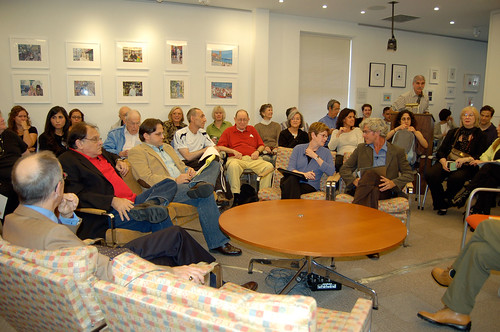
First, the good news. The Philoctetes Center's 2011 programs are off to a great start. The January 29 roundtable “The Nature of Reality,” moderated by Deepak Chopra, attracted a standing-room-only audience, many of whom returned for the subsequent roundtables in our “Big Questions” series—“The Limitations of Mental and Physical Reality” and “Theories of Everything.” In fact, turnout for our events has never been greater, and archival videos on our YouTube channel regularly attract thousands of online viewers.
Our poetry and music series continue to showcase the peerless talents of artists and scholars like Jane Ira Bloom, Lewis Porter, and Heather Dubrow, who have organized and hosted events featuring the likes of Marilyn Nelson, Jonathan Culler, Min Xiao-Fen, and Ken Wessel. And our activities have been recognized with renewed support from the New York State Council on the Arts, The New York Department of Cultural Affairs, The Axe-Houghton Foundation, The Aaron Copland Fund for Music, The Elsie Wunsch Trust, The Lindemann Abend Foundation, and Bloomberg, along with new grants and contributions from The New York Council for the Humanities, The Educational Foundation of America, Anthony Low-Beer, and, most importantly, supporters like you.
The bad news is that these funds only cover a portion of our roughly $200,000 annual budget, which has been streamlined to cover our most basic expenses: rent; utilities; salaries for our small, hardworking staff; and videography expenses (so that we can continue to share our events with an international online audience). As it stands, we currently have funds to get us through the next two months of programming. After that, we truly don’t know how we are going to continue providing what we believe is an important public service—enriching, one-of-a-kind programs that are free and open to the public.
Now more than ever, we rely on contributions from the people who enjoy our programs. Please consider supporting the Philoctetes Center with a contribution. You can access our Support page here and make a contribution by check or credit card.
Support Philoctetes
Warmly,
Francis Levy & Edward Nersessian, M.D.
Co-Directors
Showing posts with label Philoctetes Center. Show all posts
Showing posts with label Philoctetes Center. Show all posts
Friday, March 25, 2011


Friday, January 28, 2011
The Nature of Reality
January 29 @ 2:30pm
The Nature of Reality
Roundtable discussion featuring Mark Alford, Deepak Chopra (moderator), Stuart Hameroff, Menas Kafatos, David Kleinberg-Levin
In the concluding chapter of The Road to Reality, mathematician Roger Penrose asks, “What is reality?” He goes on to state, “I do not believe that we have yet found the true ‘road to reality,’ despite the extraordinary progress that has been made over two and half millennia, particularly in the last few centuries. Some fundamentally new insights are certainly needed.... Some readers may still take the view that the road itself may be a mirage. Others might take the view that the very notion of a ‘physical reality’ with a truly objective nature, independent of how we might choose to look at it, is itself a pipe dream.” Penrose’s inquiry provides the parameters for this roundtable—can physics and mathematics fully describe reality? Is it possible that reality will never be fully described within a mathematical framework, thus questioning whether mental processes and consciousness can be fully explained within the physics/mathematics paradigm? Is it possible that a future, yet undiscovered physics/mathematics will accurately define reality?
(Please Note: This event is free and open to the public. It is recommended that you arrive at least 20 minutes early to get a seat. Please do not hold seats for late-comers. Additional seating will be available for a large-screen simulcast one floor down from the event space.)
Philoctetes Center is housed at the New York Psychoanalytic Institute at 247 East 82nd St. in New York City.
The Nature of Reality
Roundtable discussion featuring Mark Alford, Deepak Chopra (moderator), Stuart Hameroff, Menas Kafatos, David Kleinberg-Levin
In the concluding chapter of The Road to Reality, mathematician Roger Penrose asks, “What is reality?” He goes on to state, “I do not believe that we have yet found the true ‘road to reality,’ despite the extraordinary progress that has been made over two and half millennia, particularly in the last few centuries. Some fundamentally new insights are certainly needed.... Some readers may still take the view that the road itself may be a mirage. Others might take the view that the very notion of a ‘physical reality’ with a truly objective nature, independent of how we might choose to look at it, is itself a pipe dream.” Penrose’s inquiry provides the parameters for this roundtable—can physics and mathematics fully describe reality? Is it possible that reality will never be fully described within a mathematical framework, thus questioning whether mental processes and consciousness can be fully explained within the physics/mathematics paradigm? Is it possible that a future, yet undiscovered physics/mathematics will accurately define reality?
(Please Note: This event is free and open to the public. It is recommended that you arrive at least 20 minutes early to get a seat. Please do not hold seats for late-comers. Additional seating will be available for a large-screen simulcast one floor down from the event space.)
Philoctetes Center is housed at the New York Psychoanalytic Institute at 247 East 82nd St. in New York City.
Tuesday, November 30, 2010
Graphic Novels
Everyone was comparing The Orange Eats Creeps to Charles Burns' Black Hole, so I finally upped and read it. I thought it was fantastic. So in the future we're going to start considering graphic novel submissions for publication.
Also, along those lines, The Philoctetes Center for the Multidisciplinary Study of Imagination at the New York Psychoanalytic Institute is hosting a panel discussion on Sunday, December 5 at 2:30 on the subject of 'The Art of the Graphic Novel.' Panel participants include Lynda Barry, Hillary Chute, N.C. Christopher Couch, Ben Katchor, and Francoise Mouly.
Here's how they introduce the panel:
"The underground comics movement in the 1960s and '70s and the avant-garde RAW magazine in the '80s and '90s established comics as an important medium for storytelling and self-expression. Since then the field has opened in many new directions. Today there are cartoonists such as Joe Sacco publishing four-hundred-page works of comics journalism about Gaza, and Alison Bechdel publishing comics-form book reviews in The New York Times Book Review. An unprecedented critical and popular interest in “graphic novels,” book-length fiction in comics, has emerged in recent years. Why is there such enthusiasm about comics in our current moment, and where is the form headed? What can this intricate, double-tracked narrative form, composed of words and images, bring to journalism, or to memoir, or to the art of fiction? How are politics and aesthetics intertwined in comics, and how are popular and so-called high cultures melded in the form? This roundtable will bring together some of the foremost cartoonists, publishers, and critics in the field to explore current and future avenues for the comics form—its strengths and capacities, and where it is headed."
Also, along those lines, The Philoctetes Center for the Multidisciplinary Study of Imagination at the New York Psychoanalytic Institute is hosting a panel discussion on Sunday, December 5 at 2:30 on the subject of 'The Art of the Graphic Novel.' Panel participants include Lynda Barry, Hillary Chute, N.C. Christopher Couch, Ben Katchor, and Francoise Mouly.
Here's how they introduce the panel:
"The underground comics movement in the 1960s and '70s and the avant-garde RAW magazine in the '80s and '90s established comics as an important medium for storytelling and self-expression. Since then the field has opened in many new directions. Today there are cartoonists such as Joe Sacco publishing four-hundred-page works of comics journalism about Gaza, and Alison Bechdel publishing comics-form book reviews in The New York Times Book Review. An unprecedented critical and popular interest in “graphic novels,” book-length fiction in comics, has emerged in recent years. Why is there such enthusiasm about comics in our current moment, and where is the form headed? What can this intricate, double-tracked narrative form, composed of words and images, bring to journalism, or to memoir, or to the art of fiction? How are politics and aesthetics intertwined in comics, and how are popular and so-called high cultures melded in the form? This roundtable will bring together some of the foremost cartoonists, publishers, and critics in the field to explore current and future avenues for the comics form—its strengths and capacities, and where it is headed."
Tuesday, September 21, 2010
Because This Sounds Important
 In, like, the '90s, my mom and the partner she ran her dance company with were on 60 Minutes for about a minute confronting a Senator from Ohio named John Kasich (now running for Governor to the state) who was garnering national media attention for trying to abolish the NEA.
The Philoctetes Center for the Multidisciplinary Study of Imagination at the New York Psychoanalytic Institute, of which Francis Levy (author of Erotomania and the forthcoming Seven Days in Rio) is a co-director (Edward Nersessian and Francis Levy, Directors), is hosting a rountable this Saturday, September 25, 2010 at 2:00pm at The Philoctetes Center 247 East 82nd Street (Phone: 646-422-0544; email: info@philoctetes.org). The rountable discussion will focus on arts funding past and present.
This event is free and open to the public.
From the WPA to the NEA: Arts Funding Then and Now
The WPA, one of the central programs of Roosevelt's New Deal, was pivotal in providing a template for government subsidy of arts projects, producing one of the great periods of creative expression in the history of American society. Playwrights like Arthur Miller and Elmer Rice flourished under the WPA’s Federal Theater Project, directed by Hallie Flanagan. Federally funded projects sowed the seeds for America's ascendency as the center of modern art, particularly with the emergence of abstract expressionism in the late ‘40s and ‘50s. The WPA and the New Deal fostered a renaissance that affected the very fabric of American society, instilling a confidence that helped lead the country back to prosperity. This panel will look at how and why the WPA stimulated creative growth during a crucial period in American history, and examine the ways in which government subsidy of the arts can foster a sense of social identity.
Morris Dickstein is the author of Dancing in the Dark: A Cultural History of the Great Depression, winner of the 2010 Ambassador Book Award in American Studies. He is Distinguished Professor of English and Theatre at CUNY Graduate Center and the author of Gates of Eden and Leopards in the Temple, among other works.
Rocco Landesman is the tenth chairman of the National Endowment for the Arts (NEA). Prior to joining the NEA, he was a Broadway theater producer. After receiving a doctorate in Dramatic Literature at the Yale School of Drama, he served there for four years as an assistant professor. He ran a private investment fund until his appointment in 1987 as president of Jujamcyn, a company that owns and operates five Broadway theaters. Landesman has produced several Tony award-winning Broadway hits, most notably Big River, Angels in America, and The Producers. He has been active on numerous boards, including the Municipal Arts Society, the Times Square Alliance, The Actor's Fund, and the Educational Foundation of America. Landesman has spoken at forums and written numerous articles on the debate surrounding arts policy.
Susan Quinn is the author of A Mind of Her Own: The Life of Karen Horney; Marie Curie: A Life; Human Trials: Scientists, Investors and Patients in the Quest for a Cure; and Furious Improvisation: How the WPA and a Cast of Thousands Made High Art Out of Desperate Times. Quinn received the Globe Winship award for A Mind of Her Own, and was awarded a Guggenheim Fellowship and Rockefeller residency to work on her biography of Marie Curie, which was a finalist for the Los Angeles Times Book Prize, shortlisted for the Fawcett Book Prize in England, and won the Grand prix des Lectrices d'Elle in France. Quinn has been a staff writer at Boston Magazine, where she won the Penney-Missouri Magazine Award for investigative journalism, and has contributed to The Atlantic and New York Times Magazine, among other publications. She is currently at work on a book about the friendship of Harry Hopkins and FDR.
Leslie G. Schultz is the Executive Director of BRIC Arts Media Bklyn, a non-profit cultural institution dedicated to supporting the creative process and presenting innovative and accessible contemporary art, performing arts, and community media programming that reflects the diverse communities of Brooklyn. Under her leadership, BRIC has rebranded, restructured, expanded its programming, developed and implemented a new strategic plan for institutional growth, and secured public and private support for the creation of BRIC Arts Media House, a multidisciplinary arts and media center designed by award-winning Leeser Architecture that will double the size of BRIC's current facilities. Prior to BRIC, Leslie was a partner at the law firm of Manatt Phelps & Phillips and its predecessor firm, focusing on capital projects for a range of non-profits and on non-profit governance and corporate affairs.
This program is supported, in part, by public funds from the New York City Department of Cultural Affairs, in partnership with the City Council.
_______________________
Events at Philoctetes are free and open to the public. Seating is on a first come basis.
The Philoctetes Center for the Multidisciplinary Study of the Imagination was established to promote an interdisciplinary approach to the understanding of creativity and the imaginative process. To achieve its mission, the Center organizes roundtable discussions and music, poetry and film series. All programs are free and open to the public. Visit philoctetes.org for more information.
Subscribe to:
Posts (Atom)

 Posts
Posts


